
The first thing my husband asked, when he came running in from the pool, was whether the cake was ruined.
Not whether I had hurt my broken leg again. Not whether I needed help getting up. Not whether the crutch that had just skidded out from under me on the wet kitchen floor had done any new damage to the ankle a doctor had told me, three weeks earlier, to stay off entirely. He asked about the cake. He stood there dripping in his new swim trunks with a sweating cocktail in one hand, and his eyes went past me, past his own mother who was holding me up under both arms, and landed on the glass cake plate that had slammed into the counter hard enough to crack the frosting straight down the middle.
“Please tell me we can fix that,” he said.
I was half hanging from Diane’s arms, my full weight dragging on a woman in her sixties, sweat running down the back of my shirt, a hot bright pain climbing from my ankle to my knee where I had wrenched the leg catching myself. And I watched my mother-in-law’s face change. I watched something in her go still and then hard, the way water goes hard when it freezes, all at once, a phase change you can almost hear.
For twelve years, Diane had been Donald’s most reliable defender. She had smoothed things over. She had told me he meant well. She had reminded me, gently, that he had grown up in a house where things were done a certain way, that he loved me in his own manner, that men of his generation and his father’s generation simply hadn’t been taught. She had spent more than a decade holding the umbrella of her own excuses over her son’s head, keeping him dry.
And in that one second, watching him look at the cracked cake instead of at me, she stopped.
For a moment, she said nothing. She just tightened her grip beneath my arms and got me steady on my one good leg, and then she turned her head toward her son, and she said, in a voice I had never heard her use with him, flat and cold and final, “Your wife nearly hit the floor.”
“But she didn’t,” Donald said.
I want you to understand that he did not say it cruelly. That is the part that took me years to fully absorb. He was not sneering. He was not being deliberately vicious. He said it the way a person states an obvious fact that has been raised as an objection, mildly, almost reasonably, as if the whole matter had already been resolved by the simple circumstance that I was, technically, still upright. She had almost fallen, but she hadn’t. The near miss was not a problem. The near miss did not require his attention. What required his attention was thirty guests by a pool and a cracked cake and the growing risk that his fortieth birthday party might, God forbid, look less than perfect.
“Talia,” he said, and here his voice warmed with the faint impatience of a man being kept from something important, “people are waiting.”
That was the moment his mother stopped protecting him.
It was also, though it had taken me far too long to arrive there, the moment I finally stopped protecting him too.
Three weeks before all of this, I had missed the last step on our back porch while carrying a basket of laundry down to the line. It was nothing dramatic. It was the most ordinary domestic accident in the world, a foot placed where it thought a step would be, a step that was one lower than my body expected, and then the sudden terrible weightlessness and the sickening crack that I felt more than heard, a sound that traveled up through the bones of my leg and into my teeth. The laundry basket went one way. I went the other. I lay on the concrete at the bottom of the porch steps with the breath knocked out of me and a pain so total and white that for a few seconds I couldn’t even make a sound.
From inside the kitchen, through the screen door, Donald called out, “Are you okay?”
He did not come outside.
I remember lying there on the concrete, staring up at the underside of the porch railing, my leg already beginning to swell inside my sock, and hearing my husband ask whether I was okay from a room I could see him standing in, and not getting up to check. I told myself, even then, that he probably assumed I’d just dropped the basket. I told myself he couldn’t have known. I was already, from the ground, with a fractured leg, building the case for his defense. That is a thing I have had to look at very honestly since. That my first instinct, broken on the concrete, was to explain him to myself.
I finally managed to call out that no, I was not okay, that I thought I had broken something, and then he came, and to his credit he did drive me to the emergency room and he did sit with me while they x-rayed the leg and confirmed the fracture and fitted the cast. He held my hand in the waiting room. He looked genuinely frightened when the doctor used the word broken. For a little while, in the fluorescent light of that emergency department, he was the husband I had married, attentive and worried and present, and I let the memory of him ignoring me from the kitchen soften and blur, the way I had learned to let so many things soften and blur.
The doctor was very clear. Keep weight off the leg. Elevate it above the heart when possible. Rest as much as I could for the first few weeks, let the bone begin to knit, do not rush it, do not push through it, do not try to be a hero about it. Donald sat right beside me and nodded at every single instruction. He nodded so earnestly. I watched him nod and I thought, he heard all of that, he understands, and I felt, for one foolish moment, taken care of.
For two days, it was almost true. He brought me coffee in the mornings and set it on the side table by the couch where I had my leg propped on two cushions. He made me breakfast, badly, eggs a little too dry and toast a little too dark, but made with an effort that touched me. He asked if I needed anything. He fluffed the cushions. He was, for forty-eight hours, a man rising to an occasion.
On the third day, he left his dinner plate beside the sink instead of in it. A small thing. The smallest possible thing. But I noticed it, because I noticed everything, because noticing everything and quietly handling it was the job I had been doing without wages or acknowledgment for twelve years, and I understood the plate for what it was. It was the leading edge of the return to normal. The occasion had passed. His attention, which had risen so beautifully, was already beginning its slow inevitable descent back to its resting level, which was to say, back to me.
By the end of that first week, he had started asking, in a bright encouraging tone, when I would be “back to normal.” As if my broken leg were a scheduling inconvenience we were jointly waiting out. As if the cast were a temporary policy I had adopted that we both hoped I would soon abandon. He never asked how the leg felt. He asked when it would be over. There is a difference between those two questions that tells you everything about a person, and I had been married to the second question for twelve years without ever quite letting myself hear it.
I was forty years old. I had spent twelve of those years being the person who remembered. I remembered his mother’s birthday and my mother’s birthday and the anniversary of his father’s death, which Donald himself sometimes forgot until I mentioned it. I remembered which of his colleagues had a new baby and which of his friends had gone through a divorce and therefore should not be seated next to their ex at our Christmas party. I bought the gifts, all of them, for both of our families, wrapped them, wrote the cards, forged his signature beside mine because he could not be bothered to sign. I kept the calendar of our life in my head, a vast invisible spreadsheet of obligations and preferences and small kindnesses, and I ran it so smoothly and so silently that Donald had come to believe our life simply ran itself, that the frictionlessness was the natural state of things rather than the product of one person’s constant, uncredited labor.
And Donald knew how to use that against me. I don’t think it was even fully conscious, most of the time. I think that is almost worse. He had simply learned, over years, that if he needed something done and did not want to do it, he could rely on the fact that I would not let it fall, that my need for things to be right, to be handled, to not embarrass us, was stronger than my willingness to let him face the consequences of his own choices. He had learned that my competence was a lever, and that he could pull it any time, and that I would move.
A week before his birthday, I was on the couch with my leg raised and an ice pack balanced on the cast, watching something mindless on the television, when he came in from the other room carrying a piece of paper. He was holding it the way a child holds a drawing he is proud of, or the way a man holds a lottery ticket he is already certain has won. He had the look of someone who has found money in the pocket of an old coat.
“Good news,” he said. “I finished the guest list.”
I lowered the ice pack. “What guest list?”
“For my birthday.”
“What are you talking about?”
“The pool party. Next Saturday.” He beamed at me. “Thirty guests. I kept it reasonable, Talia.”
I looked at him. Then I looked, very deliberately, at the cast resting across two couch cushions, at my leg that a doctor had told me to keep off the ground, at the ice pack in my hand. Then I looked back at him.
“Reasonable for whom?” I asked.
“For the house,” he said, missing it entirely, or choosing to. “It’s not a huge crowd. Half of them barely eat, honestly.”
“Great,” I said. “Then maybe the other half can cook.”
His smile faltered for the first time. He had come in expecting me to be delighted, or at least to acquiesce, and something in my tone was not cooperating with the script.
“I was thinking,” he said, recovering, pressing on, “appetizers, ribs, a couple of salads, some cocktails. And your layered cake, obviously. Everyone always asks about your cake.”
“Need,” I repeated slowly, because he had said the word need, he had said I need appetizers, I need ribs, as though these were requirements the universe was imposing on both of us equally rather than desires he had decided I would fulfill.
“It’s my fortieth, Talia.” His voice took on a wounded edge, the practiced injury of a man who has learned that hurt feelings are a currency. “Can’t I want something special? Especially from my wife?”
“And this,” I said, lifting the ice pack an inch off the cast and setting it back down, “is my broken leg.”
He glanced at the cast as if he had genuinely forgotten it was there. As if it had slipped his mind, in the week since he had sat beside me nodding at a doctor, that his wife could not stand for more than a few minutes without her leg shaking.
“You can sit while you prep,” he offered, as if this were a generous accommodation, as if he had thought hard about my comfort and arrived at a solution. “I’ll get you a chair in the kitchen. You won’t even have to be on your feet much.”
I put the ice pack down entirely and turned to face him as much as my leg would allow.
“I suggested,” I said, keeping my voice level, “a quiet dinner. You, me, and your mother. Something nice. I offered that days ago. And instead you invited thirty people without asking me a single question.”
“A quiet dinner sounds depressing,” he said, and there was real disdain in it, a curl of the lip. “It’s my fortieth birthday. I don’t want to spend it eating pot roast with my mom.”
I pushed the guest list back across the coffee table toward him.
“Then hire someone,” I said. “Order food. Or cut the guest list down to something that doesn’t require a full catering operation from a woman on crutches. Those are your options. Pick one.”
“Catering costs a fortune,” he said immediately.
“Then order prepared trays. The grocery store does whole spreads. It’s easy, it’s cheap, people love it.”
“I don’t want my birthday to look cheap,” he said, and there it was, laid bare, the actual heart of it. Not that he wanted good food. Not that he wanted a celebration. That he did not want it to look cheap, that his concern was the appearance of the thing in the eyes of thirty other people, and that he would rather that appearance be purchased with my broken body than with his own money.
I held his gaze for a long moment.
“You’d rather your injured wife cook all day,” I said quietly, “than let your friends see store-bought food.”
And he said the thing he always said, the thing he reached for whenever he wanted my effort without having to ask himself what it cost.
“My mother hosted bigger parties than this. On her own. For years.”
“Your mother,” I said, “wasn’t in a cast.”
“She would’ve managed.”
There it was. Complete. The comparison he pulled out like a trump card whenever he needed to make my limits look like failures of will. His mother would have managed. His mother had endured. His mother had made it all look effortless, and if I could not do the same, then the problem was not the thirty guests or the broken leg, the problem was some deficiency in me, some lack of the strength and grace and selflessness that real women, mothers, wives of a better generation, apparently possessed in endless supply.
I did not know, that afternoon, everything I would come to learn about what it had actually cost Diane to manage. I did not yet know what she would say to me in my own kitchen a week later, with her son laughing outside the window. But I knew, even then, that his mother would’ve managed was not a compliment to his mother. It was a debt he was assigning to me, drawn on an account of another woman’s silent suffering.
“Call the guests,” I said. “Tell them the plan has changed. Tell them we’re doing a smaller thing, or that you’re ordering in, whatever you want to tell them. But I am not cooking for thirty people on this leg.”
“I’m not canceling.”
“Then you’re cooking.”
“I can’t spend my birthday in the kitchen,” he said, and the speed of it, the reflexive immediacy of that answer, told me everything I needed to know. He understood perfectly well that hosting a party for thirty people meant a full day of labor. He was not confused about the work. He simply believed, all the way down in a place that had never once been examined, that the work belonged to me. That the kitchen was my room and the pool was his. That his birthday was a thing that happened to him and was produced by me.
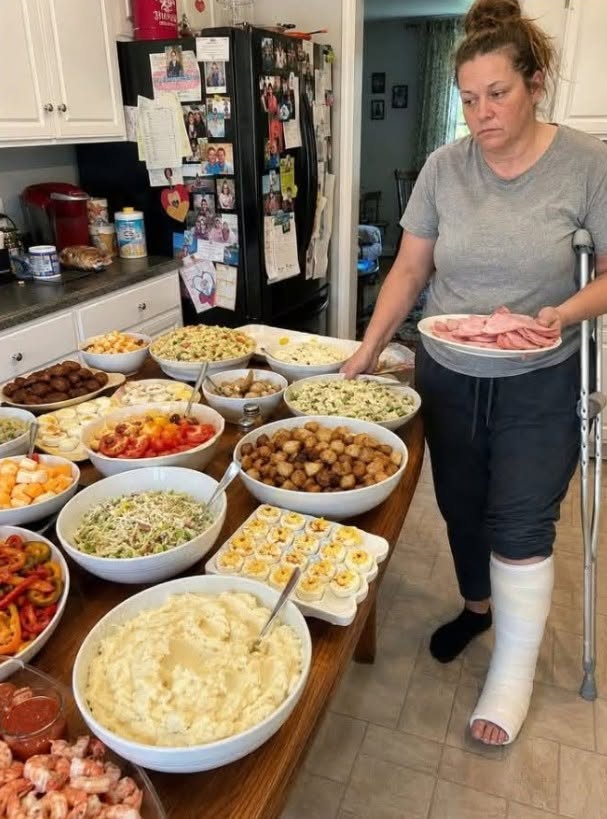
We went back and forth for a while longer. I was tired, and my leg hurt, and some part of me, the old exhausted part that had run our life for twelve years, wanted the fight to be over more than it wanted to win it. And so, eventually, we reached what I told myself was a compromise. He would order the main dishes, the ribs and whatever else, from a restaurant. I would make three appetizers and the cake. Only that.
“That’s all,” I said. “Three things and the cake. You handle everything else. The mains, the drinks, the ice, the setup, the cleanup. All of it.”
“Fine,” he said.
“Say it back to me.”
He sighed, the put-upon sigh of a man being subjected to unreasonable bureaucracy. “Three appetizers and the cake. I order the mains. I know, Talia.”
I should have known, when I had to make him say it back, that the agreement was already dead. You do not need to make someone repeat a promise they intend to keep.
Two days before the party, I crutched my way into the kitchen and found him leaning against the counter, scrolling through his phone, a cup of coffee going cold beside him.
“Send me the confirmation from the restaurant,” I said. “I want to make sure the timing works with when people are arriving.”
He did not look up from his phone.
“I didn’t place the order,” he said.
I stopped. I tightened my grip on the crutch, the rubber handle suddenly slick under my palm.
“Why not?”
“It was too expensive.” He shrugged, still scrolling, still not looking at me. “And honestly, you cook better than any of those places anyway. It’ll be better this way.”
“That was not our agreement, Donald.”
“I already told everyone about your ribs,” he said, as if this settled the matter, as if the fact that he had made promises to other people using my labor was a force of nature I was now obligated to accommodate. He gestured with his chin toward the corner of the kitchen, where I now saw, for the first time, the grocery bags. Bags and bags of them. Racks of raw ribs. Bags of potatoes. Vegetables, cheese, the whole architecture of a party’s worth of food that he had ordered delivered and left sitting there for me to find and, apparently, to transform.
“Why would you promise people food that I never agreed to make?” My voice was climbing and I could not stop it.
“Because you’re good at it,” he said simply, finally glancing up at me with an expression of mild, genuine confusion, as though I were the one behaving strangely. “You’ll figure it out. You always do.”
You always do. There was the whole marriage in three words. There was the lever he pulled. You always do, so I never have to. You always figure it out, so I never have to think about whether it can be figured out, or what it takes out of you to figure it, or whether I have any right to hand you the pieces and walk away.
See more on the next page