
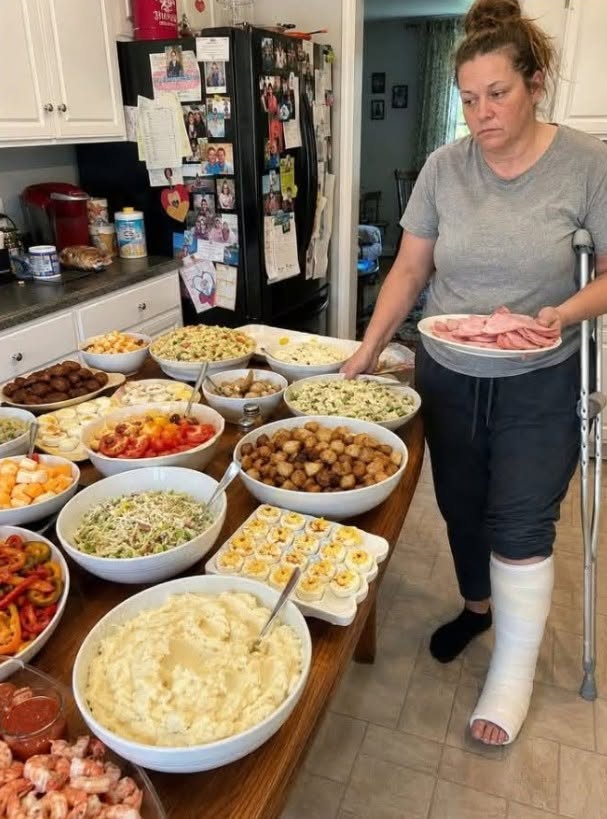
I looked at the mountain of raw food in the corner of my kitchen, food for thirty people, and I looked at my husband, rested and unbothered, and I said, “Then cook it yourself.”
And I crutched out of the room before he could see my face.
I did not sleep well that night, or the night after. And when my alarm went off at four in the morning on the day of the party, I lay in the dark staring at the ceiling and I let myself, for a few minutes, imagine not getting up. I imagined lying there. I imagined staying in bed until noon with my leg elevated exactly as the doctor had ordered, and letting the day arrive without me. I imagined thirty guests walking into our backyard at two in the afternoon to find no food, no spread, nothing but bags of raw ribs sweating on the counter and a warm case of soda and Donald standing by the pool with his charming smile and no explanation that would survive contact with the truth. I imagined it with a longing that frightened me.
And then I imagined the other version. The guests arriving, confused. Someone wandering into the kitchen, opening cabinets, looking for food that wasn’t there, and finding me, and asking, with that particular tilt of the head, what happened, is everything okay, and me having to sit there in my cast and either lie to protect Donald or tell the truth and become, in front of all of them, the wife whose marriage was visibly broken. I imagined the pity. I imagined the story that would travel afterward. And I felt the old machinery start up in me, the deep reflexive need to not let it fall, to not be embarrassed, to not let the frictionlessness break down in public where people could see the seams.
I hated that I cared. I hated it with a real and specific hatred, lying there in the dark. But I hated even more that Donald knew I cared, that he had built his entire plan on the certainty that I would care, that he could hand me an impossible task and walk away confident that my own pride and my own decency would do the work of forcing me to complete it. He was not counting on my love. He was counting on my shame. He knew I would rather break myself than be seen to have been broken.
So I got up.
I want to be honest about that, because it is not the triumphant part of the story, but it is the true part. That morning, I still got up. I was not yet the woman who would say no. I was still, at four in the morning, the woman who protected him, who protected the appearance of us, who could not yet bear the cost of letting the truth be visible. Change did not arrive for me in a single clean decision. It arrived slowly, over the course of that long terrible day, in layers, the way the cake went together, and it did not finish arriving until his mother caught me falling.
I rolled my desk chair in from the office, the one with the wheels, and I worked from it, sitting, pushing myself around the kitchen with my good foot, standing only when I absolutely had to and only for as long as my one good leg could bear my whole weight before it began to shake. I worked in painful bursts. Chop for a while, then sit and breathe through the throbbing in the cast. Stir for a while, then sit. I made two dips. I assembled a vegetable tray. I put together a salad big enough for a crowd. I mixed and baked the cake layers, three of them, and set them out to cool. By seven in the morning I had been working for three hours and had made real progress, and my shoulders were already beginning to burn from the crutches, from the constant bracing and lifting of my own body weight through my arms because my leg could not do its share.
By nine, the burn in my shoulders had become a deep ache that reached down into my back. I had frosting under my fingernails and flour on my shirt and my hair was damp at the temples. And that was when Donald walked into the kitchen.
He was wearing new swim trunks. His hair was combed. He looked rested and relaxed and entirely untouched by the last five hours, because he had spent them asleep. He walked over to the counter and dipped one finger into a bowl of dip I had made, tasted it, and considered.
“Needs salt,” he said.
I looked at him. I picked up the salt shaker from the counter and held it out to him.
“Then today’s your lucky day,” I said.
He took the shaker, entirely missing the sarcasm, and set it back down without adding any salt, because of course he had no actual interest in salting the dip, he had only wanted to render a verdict.
“When are the ribs going to be ready?” he asked.
“They’re in the big pot,” I said. “The heavy one. I need you to move it to the stove for me. I can’t lift it on the crutches.”
He glanced toward the patio doors, toward the pool, toward the morning that was waiting for him.
“I can’t really disappear into the kitchen when I’m the one hosting, Tals,” he said. “People are going to start showing up.”
“Neither can I, apparently,” I said. “And yet here I am.”
He made an irritated sound and crossed the kitchen and lifted the pot and dropped it onto the stovetop hard enough that sauce slopped up over the rim and splattered across the counter I had just wiped down. Then he turned to leave.
“I need help plating all of this,” I said to his back. “There’s no way I can carry it all out. I need you to help me get it to the tables.”
“It’s my birthday,” he said, without turning around, the words landing like a door closing.
“And it’s my broken leg,” I said, for what felt like the hundredth time, into a room he was already leaving.
He grabbed a handful of chips from an open bag on his way out and disappeared through the patio doors, and a moment later I heard music start up outside, something loud and upbeat, and under it the first sounds of arriving guests, car doors and greetings and laughter, the party beginning without me, around me, on the other side of a wall of glass, while I sat in my desk chair in a wrecked kitchen with frosting under my nails and my leg on fire.
For the next hour, the kitchen was a thoroughfare. The door swung open and shut, open and shut, as guest after guest came through looking for things. Ice. Where’s the ice? Napkins? Is there a bottle opener? Do you have more cups? Each of them found me there, sitting in my chair, working, and most of them said something kind and vague, oh this all looks amazing, you must have been busy, and then took what they needed and went back out to the pool. And every single time that door swung open, in the gap before it closed, I could see out into the backyard, and every single time, I saw Donald. Laughing. Holding court. A drink in his hand, sunglasses pushed up on his head, the sun on his shoulders, entirely in his element, surrounded by people who thought he was wonderful.
Not once, in all those times the door opened, did I see him look toward the kitchen. Not once did he glance back to check on me. His wife was thirty feet away doing the labor of his entire celebration on a fractured leg, and he did not turn his head.
And then, through the open door, I heard a man’s voice call out over the music, “Talia, this food is amazing!”
And I heard Donald laugh, that easy generous laugh of his, and I heard him say, “She insisted on doing everything herself. You know how she gets when she has a project.”
I stopped slicing the tomatoes in my hands.
I heard another guest, a woman, say something warm and teasing, “She must really love you, making all this.”
And I heard my husband, my husband, say, “Oh, she loves hosting. Honestly, I couldn’t have stopped her if I tried.”
My hand tightened around the knife until my knuckles went white.
He had not simply abandoned me in the kitchen. That, I could almost have understood, could have filed under the long list of his ordinary selfishnesses. What he was doing out there was something else. He was rewriting it. He was standing in the sun telling thirty people a story in which I had chosen this, in which I had insisted, in which my broken-legged labor was a quirk of my personality, a hobby, a thing I did for love and could not be dissuaded from. He was taking the truth, which was that he had trapped me into this through a series of broken promises and manipulations, and he was inverting it in real time, turning himself into the indulgent husband who simply couldn’t rein in his enthusiastic wife. He was not just letting me suffer. He was building an audience that would remember me as having suffered voluntarily.
The kitchen door opened again. This time it was Misha, the wife of Donald’s oldest friend, Theo. She came in carrying an empty ice bucket, and she stopped just inside the door, and she looked, really looked, in a way none of the others had. She took in the counters covered in the wreckage of hours of cooking. She took in my desk chair. She took in the crutches leaning against the cabinet, and the flour on my shirt, and the sweat in my hair, and the cast on my leg propped up on a second chair.
“Why are you in here, Tals?” she asked. And there was something in the way she asked it, something that was not vague and was not kind-and-moving-on, but was direct, and a little bit angry on my behalf, that went straight through the wall I had built to get through the day.
“Because the food refused to cook itself,” I said, trying to make it light.
She did not smile. She set the ice bucket down on the counter.
“Donald told everyone you wanted to handle everything,” she said. “He said you turned down catering because you wanted to do it all yourself.”
I couldn’t answer. Something had closed up in my throat.
“He said that,” I finally managed. It came out not as a question but as a confirmation of something I already knew and could still barely stand to hear said aloud.
“He’s been saying it all afternoon,” Misha said quietly. “To anyone who compliments the food. That you insisted. That he couldn’t stop you.” She looked at my leg again. “Do you want help? I can plate all of this, I can carry it out, just tell me what needs to go.”
“You’re a guest, Misha,” I said, reaching automatically for the reflex, the deflection, the protection of the appearance. “Go have fun. I can manage.”
“So are the other twenty-nine people out there,” she said. “None of them are standing on one leg.”
“I can manage,” I said again, and even I could hear how thin it sounded, how threadbare, a phrase worn smooth from overuse.
Misha moved closer. She lowered her voice.
“You don’t have to make this look normal for him,” she said. “You know that, right? You don’t owe him that.”
And my eyes burned, hot and sudden, because that was the exact thing, the precise thing, that no one in twelve years had ever said to me out loud. Make it look normal for him. That was the whole job. That had always been the whole job, and I had never once heard anyone name it, and hearing it named by a woman standing in my kitchen with real concern in her face nearly took the legs out from under me, the good one and the bad one both.
But I was not ready. Not quite yet. The habit was too old and the day was too long and the wall, though cracked, was still standing.
“Could you carry those trays out?” I said, gesturing at the appetizers, giving her a task instead of an answer, retreating into the logistics because the logistics were safe. “That would actually be a huge help.”
“Of course,” she said. She gathered up the trays. And before she went, she reached out and touched my shoulder, just for a second, and she said, “I’ll come back.”
“You don’t have to,” I said, the reflex again, always the reflex, always assuring people that I required nothing.
“I know,” she said.
And she left. And I sat there in the wreckage and thought, that is the difference. That is the whole difference in the world, between the people who help you because you have made it impossible for them to avoid it, and the people who help you and then tell you they know they don’t have to. Misha knew she didn’t have to come back. That was exactly why her coming back would mean something. Donald had spent twelve years doing things for me only when he had to, only when he was watched, only when the not-doing would cost him something, and I had spent twelve years calling that love.
A few minutes later the door opened again, and this time it was Diane.
My mother-in-law came in carrying a wrapped gift under one arm and a covered dish in her other hand, the way she always arrived at things, prepared, contributing, a woman of her generation who would no more show up empty-handed than she would show up undressed. And she stopped, just as Misha had stopped, when she saw me beside the stove in my chair.
“What on earth are you doing, honey?” she said.
“Finishing the cake,” I said.
“I can see that. Why are you doing it alone?” She set the covered dish down and looked around the kitchen, at all of it. “Where is everyone? Where’s Donald?”
“Donald wanted a proper birthday,” I said. I was still, even then, softening it. Still translating his selfishness into something gentler for his mother’s ears, the way I always had, the way I had been trained to.
She glanced through the window toward the pool, toward her son laughing in the sun.
“He always did love a big fuss,” she said, and there was a fondness in it, an indulgence, and it disappointed me so deeply that I had to look down at the frosting knife in my hand. Even now. Even seeing me in a cast in a wrecked kitchen, her first instinct was the same one mine had always been, to file his behavior under harmless quirk, boys will be boys, that’s just Donald.
I spread frosting between the cooling layers and said nothing.
“Didn’t he order food?” she asked after a moment. “He told me on the phone he was having it catered.”
“He decided it cost too much,” I said.
“Did he help you this morning?” she asked. “With all this?”
I kept working the frosting. I did not answer.
“Talia,” she said.
“No, Diane,” I said. “He did not help me this morning.”
Her mouth tightened. I watched it happen. Some small foundation shifted in her.
“He told me,” she said slowly, “that you were excited about hosting. That you’d wanted to do a big party for his birthday.”
And something in me, worn down past the point of translating, past the point of softening, simply gave way.
“Donald also thinks that dropping his wet towel on the bathroom floor counts as putting it away,” I said. “He tells himself a lot of stories about how things get done in this house.”
She almost smiled. The corner of her mouth twitched. And then I shifted my weight in the chair to reach a far layer of the cake, and the movement wrenched my leg, and a bolt of pain shot up from my ankle so sharp that I hissed and gripped the edge of the counter.
Diane saw it. She saw the whole thing, the wince, the white knuckles, the sweat.
“How bad is it?” she asked. “The leg. Right now.”
“I’m fine,” I said.
“No,” she said. “You aren’t. How bad is it?”
I set down the frosting knife. I was so tired. I was so tired of the word fine, which I had said perhaps ten thousand times in twelve years and which had never once been true in the way I meant people to take it.
“The doctor told me to stay off it completely,” I said. “For the first few weeks. No weight. Elevated. Rest.”
“And Donald knew that?” she asked. “He knew the doctor said that?”
“He was sitting right beside me in the office,” I said. “He nodded at every word.”
Diane went very still.
For years, for our entire relationship, I had softened the truth for this woman. I had protected her from the full picture of her son, partly out of kindness and partly out of a cowardice I could dress up as kindness, because it was easier than the conversation, because I did not want to be the daughter-in-law who came between a mother and her son. I had let her keep her comfortable version of him. But that day, standing at that stove with my leg on fire and frosting drying on my hands and my husband’s laughter carrying in through the window, I had nothing left with which to soften anything.
“He told me,” Diane said quietly, “when I called this week, that you would have done all of this without complaining. That’s how he put it. He said, you know Talia, she’d never let a little thing like a broken leg stop her, she wouldn’t even complain.”
I looked at the counters, at the mountain of food I had produced from a chair, and I gave her the truth.
“He’s right,” I said. “I probably would have. That’s exactly the problem, isn’t it. I probably would have.”
Diane pulled out a chair from the little kitchen table and sat down heavily, across from me, and for a long moment she did not say anything. She looked at her hands. And when she spoke again, her voice had changed. It had gone quieter and further away, the voice of a woman looking at something across a great distance of years.
“Donald’s father,” she said, “expected every holiday to look effortless. Every Christmas, every Easter, every birthday, every dinner with company. Everything perfect, everything gleaming, and no evidence anywhere of the work it took. He wanted the magic without the machinery.” She turned her wedding ring on her finger, an old worn band. “And he helped, sometimes. Oh, he’d help. When people were watching. He’d carry a platter out to the table with a big flourish, right in front of the guests, and everyone would say what a wonderful husband, so hands-on, and then the guests would leave and I’d be at the sink until midnight and he’d be asleep in his chair.” She was quiet a moment. “I told myself that staying quiet about it made me strong. I told myself that was what a good wife was. That the not-complaining was the whole point, that anyone can do a job but only a real woman does it without ever letting it show.”
“Did it?” I asked. “Make you strong?”
She looked up, toward the window, toward the pool, toward the sound of her son, and when she answered her voice was flat and clear and terribly sad.
“No,” she said. “It made everyone comfortable except me. For thirty years. It made everyone comfortable except me, and it taught my son that this is what a marriage looks like. That there is a person who produces the comfort and a person who enjoys it, and that if the producing person never complains, then everything is fine, then everyone is happy, then that is simply how it is done.” She looked at me. “I taught him that, Talia. Not with words. With thirty years of never once letting him see the cost. He learned exactly what I showed him.”
The cake was finished. It needed only to be moved to the platter on the far counter and taken outside. I reached for my crutch.
“I’ll carry it,” Diane said, starting to rise.