

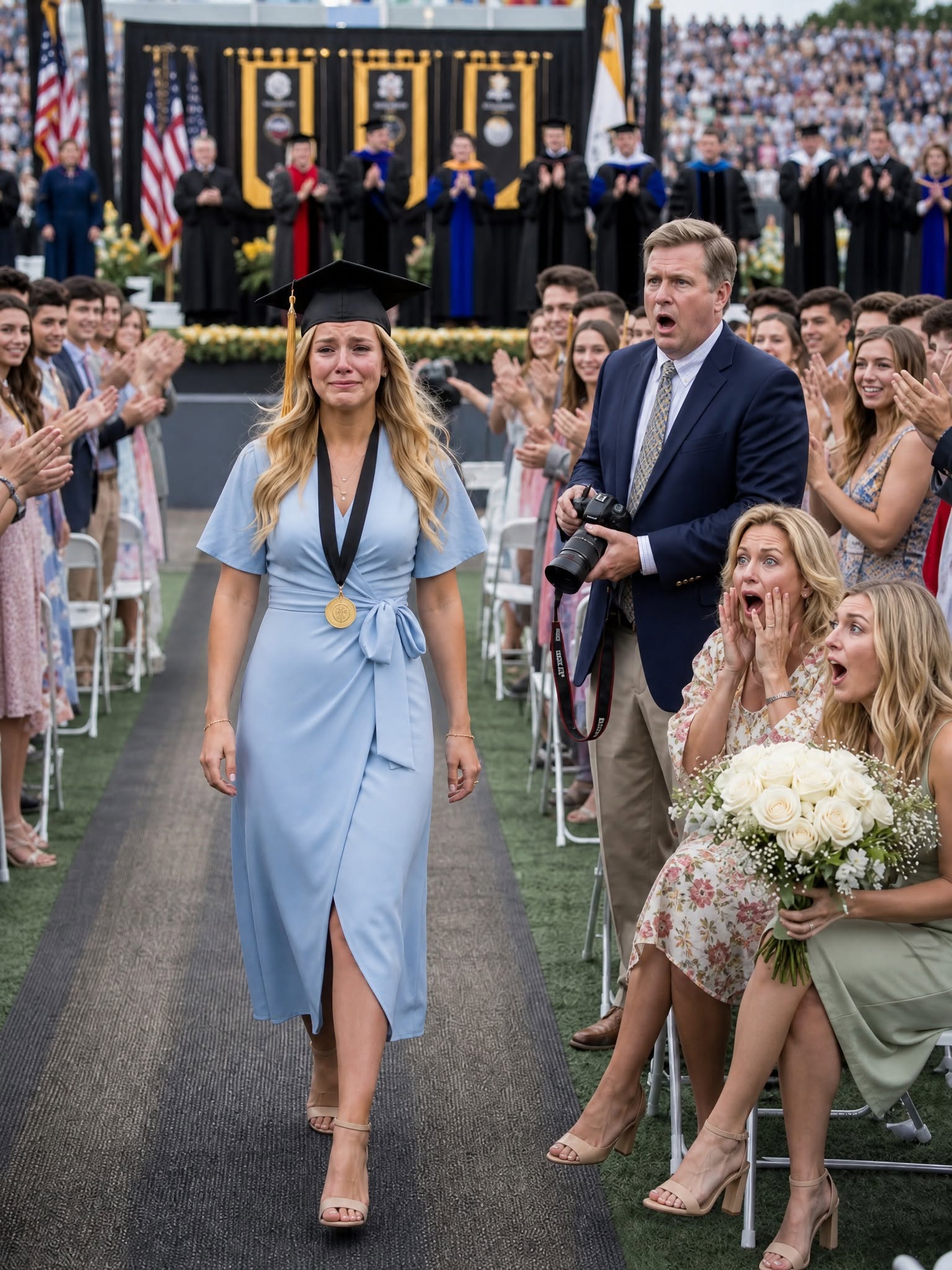
“You have always been independent,” he replied. “Consider this an opportunity to prove it.”
That night, I applied for every scholarship, work-study position and private grant I could find. River Valley offered me a partial academic award, but I would still need loans and a job to cover housing.
By August, Brooke had received new luggage, a laptop and a car for traveling between campus and internships. Dad handed me an envelope containing two hundred dollars and drove away before my bus arrived.
Inside the envelope was a note written in his neat business handwriting.
Use this wisely. There will not be more.
I kept the money but folded the note into my wallet. I wanted to remember his exact words when exhaustion tempted me to quit.
Three months later, while Brooke posted photographs from formal dinners and football games, I worked morning shifts at the campus café and spent my evenings in the economics lab. I assumed no one important had noticed me until Professor Robert Maxwell returned my first research paper without a grade.
“Did I do something wrong?” I asked.
He locked the classroom door after the other students left and placed my paper beside a confidential financial report. The cover displayed the name of my father’s company.
“Sullivan Commercial Flooring,” he said. “Is Thomas Sullivan related to you?”
“He’s my father.”
Professor Maxwell studied me carefully. “Then you should know that the economic model in your paper predicts exactly how his company will collapse.”
He opened the report to a page marked in red. “According to these numbers, that collapse has already begun.”
Part 2: The Warning He Threw Away
Professor Maxwell explained that his report had been assembled from public court filings, contractor complaints and municipal bidding records. Sullivan Commercial Flooring appeared successful from the outside, but my father had borrowed heavily to expand into three states while several major clients were already paying late.
My research paper examined the danger of expanding a family company faster than its cash flow could support. I had unknowingly described my father’s strategy almost line by line.
“You saw the pattern without knowing whose numbers you were studying,” Professor Maxwell said. “That is not luck, Maya. That is judgment.”
He encouraged me to prepare a short analysis and send it to Dad. I resisted because I knew exactly how my father would react, but part of me still wanted to protect the company that had paid for our home and employed nearly two hundred people.