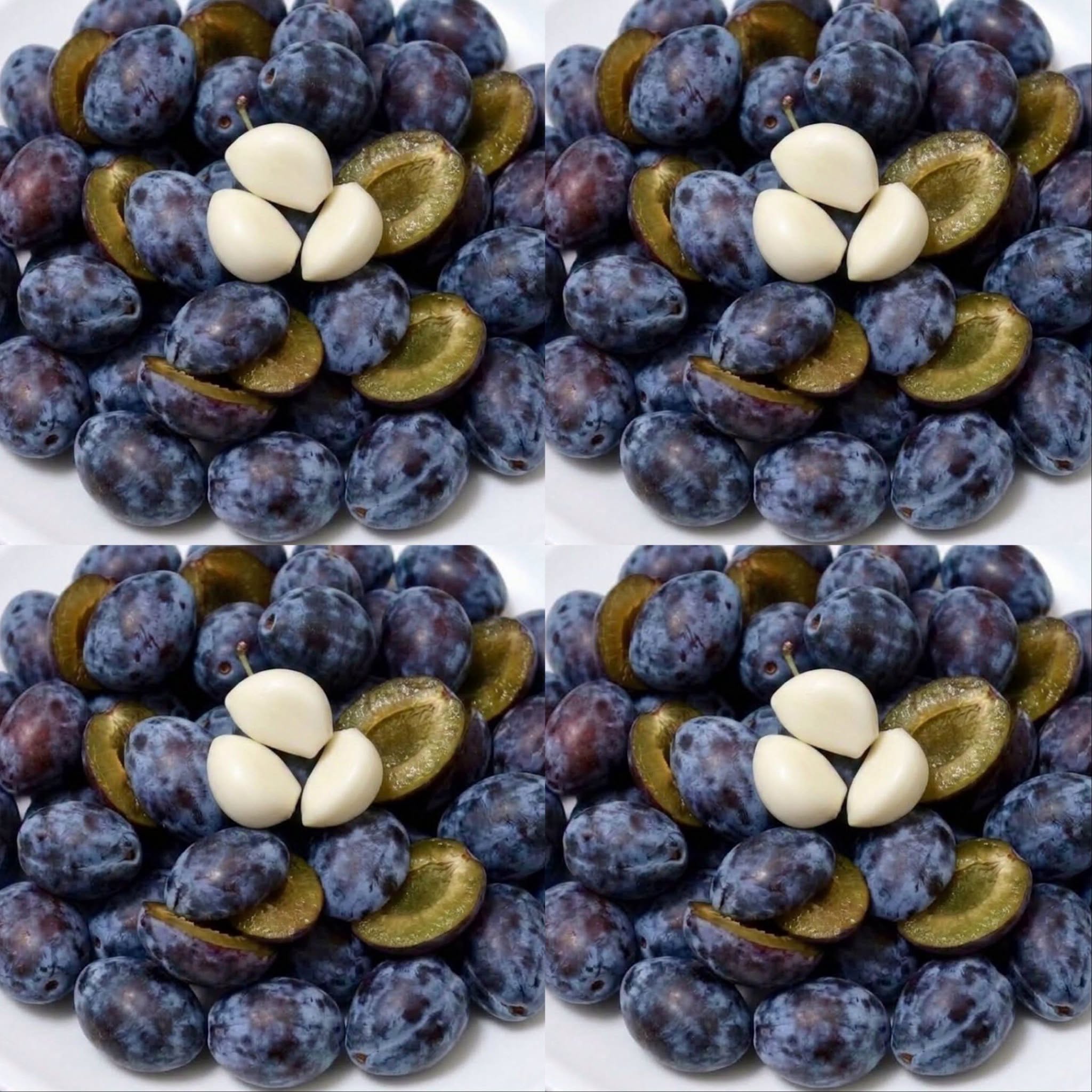
I Couldn’t Walk, but Now I Can Run! Eat 2 Tablespoons Daily for Joints and Intestinal Cleansing

intestinal microbiome is an enormous ecosystem.

There’s no single food capable of “resetting” it overnight.

But eating a diverse range of fruits, vegetables, legumes, whole grains, nuts, seeds, herbs, and spices provides the microbiome with a much richer dietary environment.

Prunes can simply be one member of that team.

3. Garlic Contains Fascinating Sulfur Compounds

Now we reach the second ingredient.

When a garlic clove is intact, its chemistry is different from what happens after you crush or chop it.

Damage to the clove allows compounds and enzymes that were previously separated to interact.

This leads to the formation of allicin, one of garlic’s best-known sulfur-containing compounds.

Allicin is unstable and transforms into other sulfur compounds relatively quickly.

Those compounds are responsible for much of garlic’s unmistakable aroma—and much of the scientific interest surrounding it.

Image
Image

4. Garlic Has Been Studied in Relation to Inflammation

Garlic and its sulfur compounds have

been investigated in experimental and human research involving inflammatory and oxidative pathways.

That doesn’t mean garlic functions like an instant pain medication.

But it helps explain why garlic appears so frequently in dietary patterns associated with health.

It’s also worth noticing what normally surrounds garlic.

People rarely eat garlic completely by itself.

They add it to vegetables, beans, soups, fish, tomato dishes, and other minimally processed foods.

So once again, one “healthy ingredient” can become a gateway to an entire healthier meal.

5. What About Aching Joints?

This is where the viral claim needs some perspective.

Joint discomfort can have many causes, and no mixture of prunes and garlic can promise to turn someone who cannot walk into a runner.

But nutrition still matters to the tissues that allow us to move.

Prunes provide several micronutrients and polyphenols, while garlic contributes its own sulfur-containing compounds.

Research has also explored prunes

Leave a Reply

Your email address will not be published. Required fields are marked *